
New Series: What We Build
A Builder's Case for Rethinking the American Home

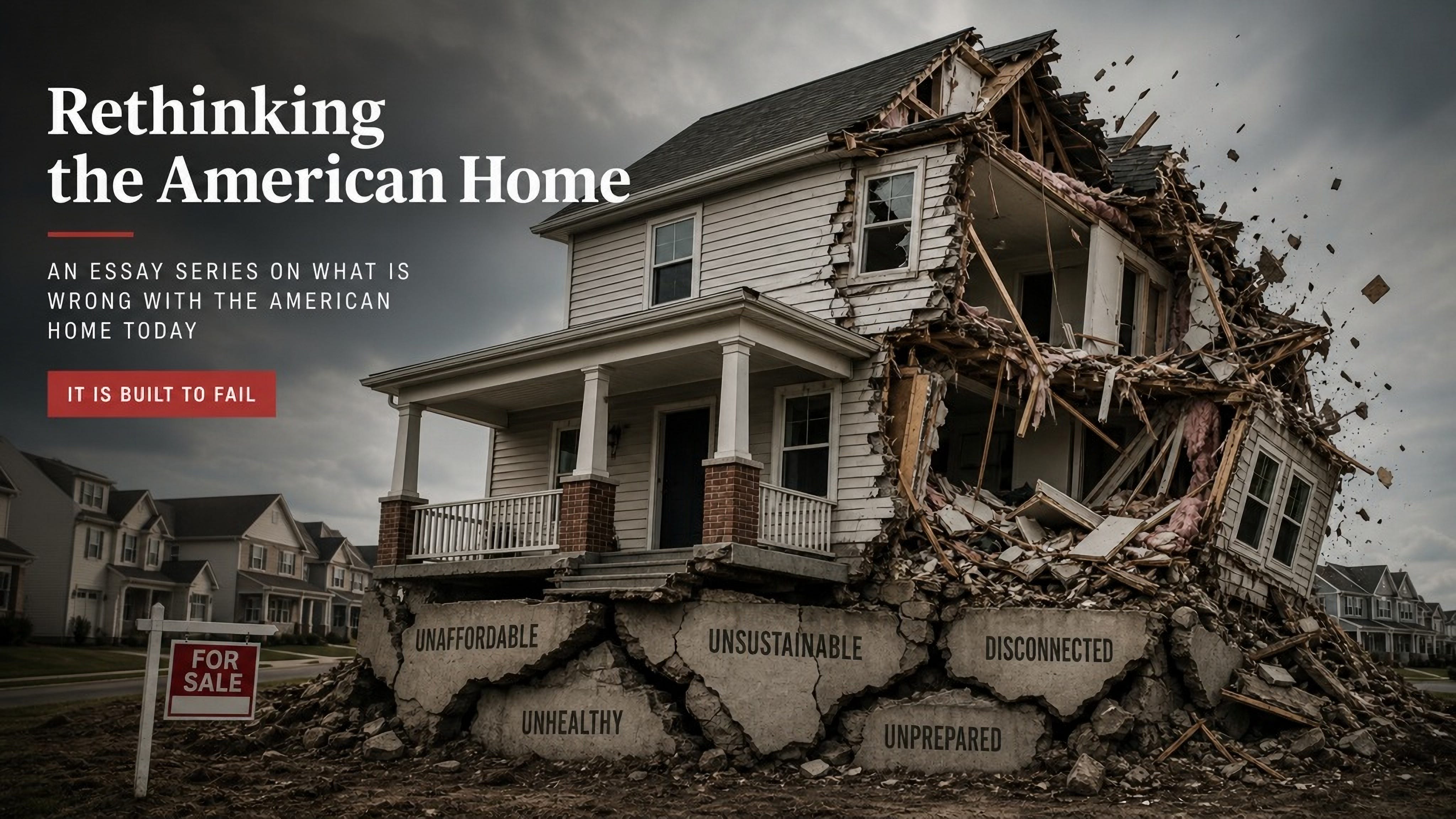

The housing crisis has a story we keep telling ourselves.
Too few units. Too much regulation. Too little political will. Interest rates too high, land too expensive, zoning too restrictive. The story is not wrong. These forces are real and their weight is considerable. But the story is incomplete in a way that matters. Because it locates the crisis entirely outside the home, in the policies and markets and financing structures surrounding it, while leaving the home itself unexamined.
What are we actually building?
Not in the aggregate. Not units per year or square footage per capita or median sale price. But in the specific, physical, material sense. What goes into the homes Americans live in. How those components are selected. Who decides what standard they meet. How long they are designed to last. And what happens to a family’s financial life when the answer to that last question turns out to be: not very long.
This is the question the housing conversation almost never asks. And its absence is not incidental. It is the gap through which the real crisis has been quietly passing for decades.
I have spent my career in the American construction industry. Not as an observer or an analyst. As a builder. Someone who has made decisions about what goes into homes, managed teams responsible for producing them, and watched the gap between what was possible and what the industry accepted widen year by year.
From that position, I can tell you something that the policy conversation rarely surfaces: the problem is not only that we build too few homes. It is that the homes we build are not worthy of the lives we expect them to support.
The American construction model, as it currently operates, produces homes assembled inconsistently, from components selected by habit and cost-at-the-moment, without coherent systems, without lifecycle thinking, and without any meaningful accountability for long-term performance. We have normalized this. We have called it affordable housing. What it actually produces, for too many families, is a slow financial drain. A home that costs more to maintain than it was ever designed to sustain. That fails at the moments when failure is most expensive. And that quietly erodes the stability it was supposed to provide.
A cheap home that fails frequently is not affordable. It is deferred poverty.
This series is a builder’s examination of that failure. Not a policy paper. Not a political argument. A practitioner’s reckoning with a system I have worked inside, pushed against, and ultimately concluded cannot be fixed from within. Only redesigned from the ground up.
It will move through five essays. The first names the standard the industry has settled for and what it costs when one person tries to hold a different line alone. The second examines what the disposable home actually is and how it came to be the default. The third follows the human cost downstream: into families, budgets, communities, and the quiet erosion of the dignity a home is supposed to protect. The fourth describes what a different model looks like, and why every industry that takes performance seriously eventually arrives at the same place. The fifth asks the question the series has been building toward: what do we choose now, and who has the courage to choose it.
The housing crisis will not be solved by building more of what we have been building. It will be solved when we remember what a home is actually for, and build accordingly.
I have spent my career trying to hold that standard. This series is an attempt to make the case that the standard should no longer be optional.
What we build determines how we live. And right now, we are not building well enough.
Next: Essay 1: The Outlier Standard. What a career spent ahead of the standard reveals about the system left behind.